
I Am Their Mother
A postpartum case study in bias, fear, and the paperwork that mothers us all.

Author’s Note
Each Dispatch is drawn directly from my medical and legal records documenting my March 2024 hospitalization. All events and quotations are contemporaneous to those records.
I promised these Dispatches would be funny, furious, and true. This one is only two of those things — furious and true. Humor can’t live here yet; it shows up only after the truth has somewhere safe to stand.
💌 Subscribe to Dispatches From the MiddleFunny. Furious. True.
First they took my tubes — without consent.
Then they took my babies — without cause.
This is the story of how I was separated from my newborns after their birth — and why I think it happened.
When sexism, bias, and a breakdown in communication collide on a maternity ward, the result is chaos. That chaos, for me, was formalized as policy and carried out as care.
What follows isn’t just my story; it’s an indicator — of how little we still understand, let alone respect, mental health.
And of how quickly things can spiral when fear overrides reason.
We talk about “wellness” as if it’s binary — healthy or sick, sane or unstable — but the human mind doesn’t work like that.
When medicine can’t read a mind, it fills the gaps with fear.
It Started as Bizarre; It Ended Supervised
One note in my electronic medical record changed my life:
“Have someone with her when bringing the newborns.”
It was a recommendation written by a psychiatrist approximately ten hours postpartum.
For three days after it was entered, I was allowed to see — but not hold — my babies.
I didn’t know it existed until the nurses stopped placing my babies in my arms. No one told me what was going on or why.
I deserved an explanation — I’ve never gotten one.
Instead, they used euphemisms and care performances to make it seem like they were doing me a favor — by doing everything for my babies that I wanted, and should have been allowed to do myself.
That single sentence — “Have someone with her when bringing the newborns” — signed, unexplained, and without definition, turned the first days of the twins’ lives into a supervised spectacle.
And that sentence came from a single part of my chart — a single word: bizarre. This is all I have to explain what was perceived as ‘bizarre.’ It’s memorialized in the psychiatric consult:
“Psychiatry was consulted due to the patient presenting with bizarre behaviors after the delivery of twins.”
After four HIPAA requests, that one sentence remains the only mention of the behavior that resulted in the separation.
So first, a nurse described my postpartum behavior as bizarre. Then psychiatry documented that description — not as an observation, but as a premise. A premise the psychiatrist then relied on in his consult to justify the recommendation: “Have someone with her when bringing the newborns.”
After that, my story was written in permanent marker — This one is crazy.
Our hospital room became a zoo; our family, the non-consensual stars of the show — with me as the main attraction. I was the exhibit. The lesson. The warning.
I heard what the nurses and staff thought but didn’t say: You are an unfit mother. You are dangerous. You are a bad mom.
Once a woman is called “crazy,” her protection disappears — and in its place, suspicion takes hold.
For a man, “crazy” is a silly description for your favorite uncle. For a woman, it’s loaded and dangerous — the difference between being seen as credible or as something without humanity entirely.
I know from experience that a “crazy” woman is no longer a person but a creature — a thing deemed incapable and unworthy of the most basic act of love: holding her own child. And once you’ve been turned into a creature, no one listens when you try to turn back.
I try not to remember the hospital, but when I do I remember Mini M and CC swaddled: Mini M sleeping, but CC wide awake. Her bright, knowing eyes stared into me — tiny fist, wild sprout of dark hair, eyes filled with wisdom and depth. I could stare back, but I wasn’t allowed to touch her.
I remember comforting myself with the belief that we were breathing the same air.
How Did It Happen?
It started because I was agitated after a preventable allergic reaction to medication.
During the C-section — and three times thereafter — I was administered cephalosporin despite a documented lifelong allergy. As the hours of unbearable itching dragged on, frustration became agitation.
A nurse labeled that agitation “bizarre.” That label triggered the psychiatric consult, which repeated the word and formalized it as diagnosis. From there, supervision became policy — and policy became punishment.
If just one person had paused to question their bias or risk being wrong, it might have stopped this from snowballing. But no one did. And I’ve been trying to undo the damage it caused ever since.
March 3, 2024, around 10 a.m.
Less than twelve hours postpartum, a nurse told me psychiatry was coming “to determine whether a hold was necessary.”
“Why?” I asked. She didn’t know. “Night-shift note said bizarre behavior.”
At 10:15 a.m., I texted my husband — home juggling two toddlers and twenty texts from me:
“The doctor who’s obsessed with me has come in four times — the man from the C-section. Apparently psych cult [sic — lol] coming later. But most importantly, a lady with a menu just came so imma eat the next person who walks in if not.”
Lucid, albeit hangry; sarcastic, not psychotic. Still funnier than anyone in that room.
Postpartum minds are noisy — chemical, exhausted, flooded with adrenaline and awe. A healthy mind can look unsteady; an unwell one can look composed. The difference takes time and listening — neither of which I was granted.
The consult happened; I thought it went fine.
Afterward though, people began to act strangely. I noticed I was never left alone. I began to crave time with the babies without audience or commentary. Each request to hold or feed Mini M and CC met new resistance.
I opened MyChart, looking for answers. I found the psychiatric consult that defined me:
“Appearance: disheveled, appropriate attire, pale. She made goog (sic) eye contact.”
“Not manic or psychotic at present but anxious and inattentive. No imminent risk to self or others.”
Then the “impressions” section:
“There might be a Bipolar Type II undiagnosed. She was educated (sic) Mood disorder. ADHD.”
I get a kick out of that one-word ADHD sentence. ADHD what, dude? The vibe? The décor? — Ha.
Okay anyway, now onto the serious recommendations:
“No need for 1:1 but recommend family member to be with her at all times if possible.”
“Not meeting criteria for inpatient psychiatry however her behavior need to be monitor.”
‘Have someone with her when bringing the newborns.’
“Team will continue to follow up tomorrow morning.”
I re-read the body of the consult: it said I was fine. Pale and disheveled, yes — but not a safety risk, and not in acute psychiatric distress. Yet my reality didn’t reflect those findings. I was suddenly untrusted with my newborns — and I knew it.
Baffled, I searched for the mistake — a copy-and-paste uh-oh situation, maybe?
There was no mistake, though — I mean, there was (hi, hello, Captain Obvious), but what I mean is that the recommendations were intentional.
The decision that doctor made was not grounded in medicine or protection.
It was fear — typed as policy, institutional protection framed as healthcare.
And we paid the price.
I learned through experience that when someone floats the suggestion of instability and you’re a woman, you don’t get the benefit of the doubt. You get the opposite.
Citizen Kane of Hospital Notes
You know what’s truly bizarre? Not a postpartum woman agitated in the middle of an allergic reaction — no. It’s nurses documenting snacks like state evidence:
“Established rapport with patient while bottle-feeding Baby A ‘Mini M’ and Baby B ‘CC.’ Husband went out to dinner. Pain medicated; encouraged patient to rest. Observed patient eating hoagie, chips, cookies, salad, soup, mac ’n’ cheese during one-hour visit. Husband returned; infants to nursery for bath and 24-hour testing; patient later noted sleeping. Nursery bottle-fed q3 overnight to prioritize maternal rest.”
They were gathering evidence — bizarre evidence — not providing care. I was postpartum and on trial. Every action, every word had to be calculated through that lens. I was being watched.
This note is hilarious — and besides the twins (and their big sisters), it’s the only good thing that hospital gave me. Okay fine, the quesadilla was pretty good, too... and the big water cups.
March 4 — “Baseline,” Still Restricted
Each day the spectacle of care was performed again and the preconception confirmed.
March 4 at 8:53 a.m., a psychiatrist wrote:
This morning the patient has been appropriate and calmer. Patient has not had any bizarre behaviors or made any concerning statements. She was not restless, hyperactive, or agitated this morning. She seems appropriately bonded to her babies per husband. Treatment team on the OB floor (nurse and SW) noted that the patient has been mostly sleeping this morning.
“Mental status returned to baseline… patient near (or at) baseline. Agree that interactions with babies should be supervised until full exam completed.”
From bizarre to baseline, it didn’t matter. Supervision stayed.
I’m a lawyer, and I saw plainly what was happening to us.
It was liability over love. The medical staff protected the institution and themselves, not us.
“You Need Rest, Mama”
They said it softly, like the lullabies I was supposed to be singing: You need sleep, Mama.
But I didn’t need sleep. I needed my babies.
“We’re taking them to the nursery — you need a break.”
I texted my husband:
“They just took them despite me saying no thanks. What Mama really needs is a menu, which she’s asked for three times.”
Later, sharper:
“They’re my fucking babies. I am their mother. They don’t trust me in a room with them.”
Those messages are timestamped proof of clarity — cognition, humor, hunger all intact.
I wasn’t unstable; I was unheard. I wasn’t crazy; I was hurting.
March 5 — Escalation Without Cause
Behavioral-health note:
“On my exam patient sleeping, awakens easily to voice.
She is calm, cooperative, coherent.
Husband … has no concerns … Hypomania appears improved.”
“Disposition – no clear indication for acute inpatient psychiatric hospitalization … Patient does not appear overtly manic or psychotic.”
But then the same pattern appeared in the recommendations:
“Interactions with infants were not observed … Husband did not endorse any concerns … I recommend reach out to CYS if team has concerns for interactions with newborn infants.”
Reach out to CYS (“Children and Youth Services”)? Had I read that right? No new behavior, no new findings, no safety risk — just a paper trail expanding to protect the hospital, not the babies.
She hadn’t observed me with the babies — no one ever had — but it didn’t matter.
My husband had no concerns. That didn’t matter either — in the hierarchy of healthcare, a father’s voice carries no authority once a mother is labeled unstable.
A CYS referral was floated because my behavior in the immediate postpartum hours had been described as “bizarre.”
That is terrifying for all of us.
But this is what happens at the mere suggestion of instability. If someone credible floats that suggestion and you’re a woman, you’re damned if you do — damned if you don’t.
You can be a white, privileged lawyer — 10/10 for looks and personality — but that Kappa Kappa Gamma sparkle won’t help you wriggle out of history and gender norms.
A woman’s chart fills faster than her voice can catch up — especially once a specific diagnosis is suggested (see: “possible bipolar”).
March 6 — Discharge and Damage
By day four we were still there because psychiatry hadn’t “cleared” me. That was the only reason we couldn’t leave — and that reason wasn’t reasoned. It was impulse.
Finally, I was cleared. The day had slipped away; I wanted the twins to meet their big sisters before bedtime.
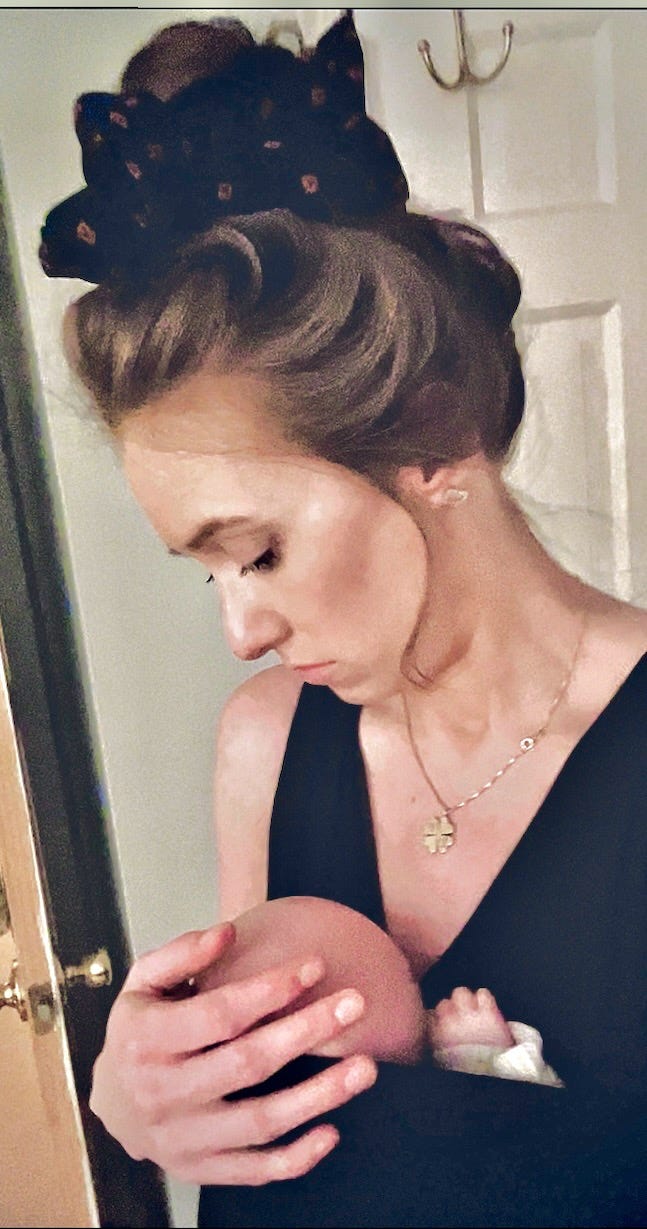
Hours passed. Finally, I could hold the twins for a photograph. That photo is precious to me now — not just because it represented my reunion with the twins, but because it represented strength in the face of terror and poise against all odds. It’s proof that my flame still burned, just lighter than before.
The photo took two seconds. It took hours to find my Adderall they had taken and lost. None of the other medications I’d brought — including another controlled drug — were confiscated and “locked up” at intake. I’ll let you think about why that is. But the irony wasn’t lost on me: they didn’t trust me with it; so they took and lost it.
I remember the moment the nurse gave me the discharge paperwork. The nurse I’d tried so hard to please was now doing the same to me. After birth, I’d given the nurses laminated four-leaf clovers for luck. Should have kept one for myself, eh?
The nurse chatted away as they wheeled me toward my salvation. She’d already won concert tickets! Well hippity-hoo for you, lady. You wouldn’t let me hold my infant daughter this morning; do not bestie me right now, I thought as I smiled and gushed over how super it all was.
I looked over the discharge paperwork in the car. No mention of any allergic reaction. Nothing about any mental-health diagnosis and no reference to the supervision that had occurred. It also didn’t mention the sterilization I hadn’t consented to. I know, shocker.
All my life until the birth of my twins, I felt I was in control of my narrative. I was the author of my story. Then for four strange, sad days it had been hijacked by something with more weight than my voice — my medical records.
Another caution: in the age of electronic medical records, “possible bipolar” can and does become “a history of bipolar” that even fourteen HIPAA requests for amendments cannot correct, let alone erase. The records they didn’t want made never were. The ones I wish hadn’t been were. The truth is what I’ve written here. And in publishing this, I am challenging their record with one of my own.
By the time we left, there was half an hour before bedtime. We carried them home together — stunned but intact. The girls met their brother and sister and then it was lights out.
Four days of supervised motherhood, one last stolen moment.
That’s what bias costs—the very moments that make us mothers.
Author’s Note (Coda)
This story is drawn directly from my medical and legal records.
I share it not for sympathy but for accountability — to show how documentation language, unchecked bias, institutional fear can turn care into control — and in honor of the people who stayed beside me while I fought to be believed. Every quotation, text, and timestamp comes from contemporaneous records.
I write this as both a lawyer and a mother: one who has seen, in real time, how a single adjective in a chart can metastasize into policy, surveillance, and separation.
What happened to me could happen to anyone, and does — quietly, every day — to women without the resources or privilege to contest it.
I know this story can be hard to read — it was even harder to live. I share it not to accuse, but to illuminate what happens when bias replaces listening — so that what happened to me doesn’t keep happening to others.
If the story makes you uncomfortable, it’s doing its job.
The discomfort isn’t the danger. The silence is.
Disclaimer: This essay reflects my personal experience and understanding as a patient and advocate. It does not constitute legal advice and should not be interpreted as commentary on any ongoing or potential litigation. Names of hospitals and clinicians have been omitted to protect privacy.
Have you ever been disheveled?
You’re in good company.
💌 Subscribe below to join the conversation — and the chaos.
If you’re new here, two more from the archive:
I KNOW WHAT HAPPENED. — three deliveries at Bryn Mawr Hospital. Preeclampsia undiagnosed with seizures for me and baby (2021); the placenta they forgot to deliver and 2.5L of blood I lost (2022); and the allergic reaction, narcan administration, a thirteen-hour gap, and a psychiatric consult no one could explain (2024). And so very much more — all worse than the last. If I didn’t keep such good records, I wouldn’t believe it myself.
The Lost Year — I slept through a year of my children’s lives. This is the story of how I disappeared. And how I came back.
I’m floored by how many of you read, shared, and reached out after I Am Their Mother.
When I first wrote it, I thought maybe a few people would read quietly and move on. Instead, so many of you stopped, sat with it, said, “Me too.” And then shared your stories with me.
This growing network of stories has power — more than I can say. Thank you for seeing what I was trying to do, for proving that honesty still travels, and that maybe the truth really can find its way out of a chart. 🖤
“I learned through experience that when someone floats the suggestion of instability and you’re a woman, you don’t get the benefit of the doubt. You get the opposite.” - this hurts to even read. I lost my sister to mental illness (and thanks to oversight by doctors and prescription pills) and as a high school counselor, truer words have never been spoken. Even, as you said, for a privileged, educated, attractive white woman. It’s not safe for any of us. So so so sorry this happened to you, it’s heartbreaking, but I am so glad you’re speaking out. I look forward to reading the rest of your journey!