
The Lost Year
The real Sleeping Beauty—a beautiful mother who could only wake when she received her true love’s… supplemental oxygen and CPAP. Only took two years and twenty doctors to get here, but who’s counting.

Funny. Furious. True. 🖤
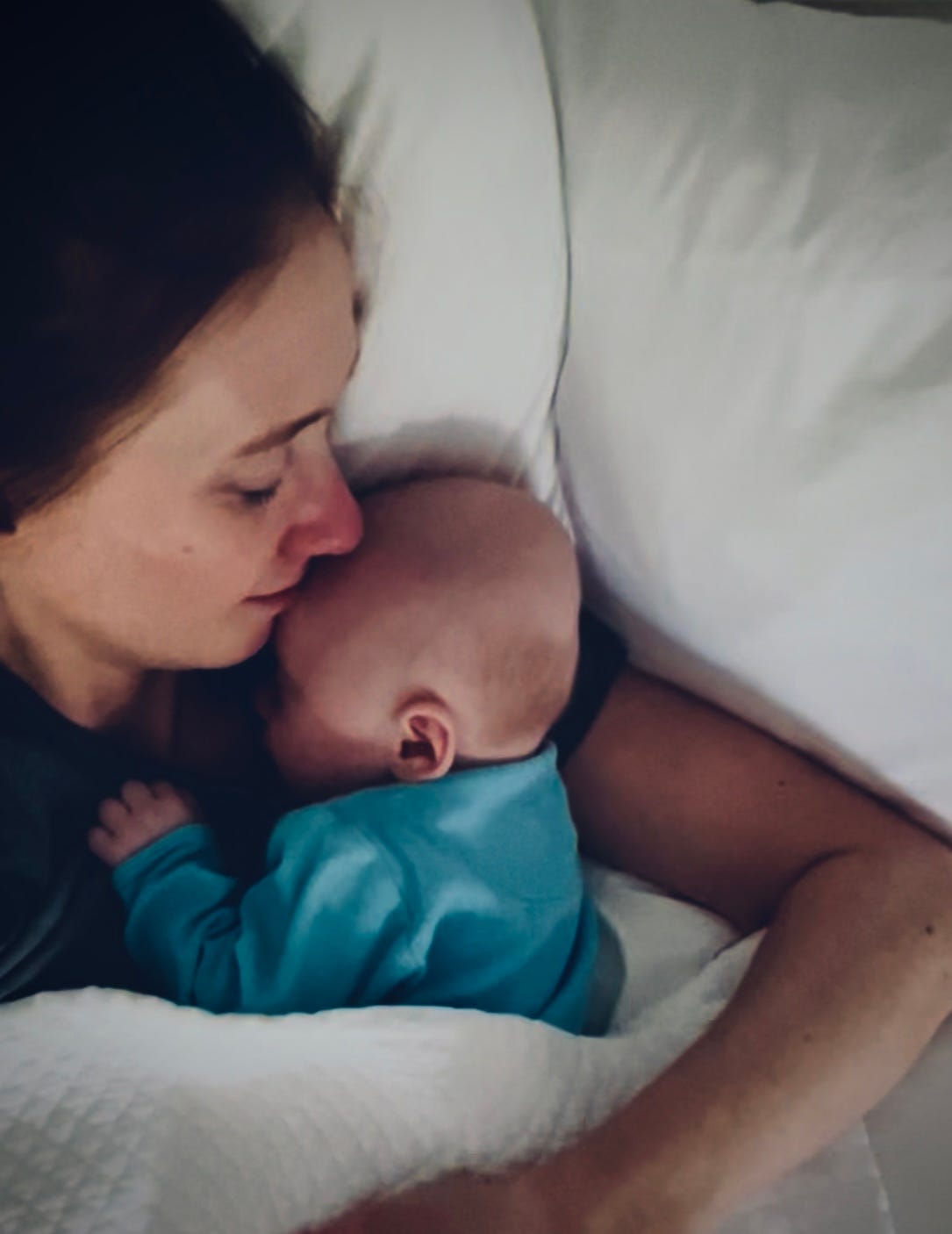
Some stories don’t begin until after the fire.
This one waited almost two years for me to crawl out of the wreckage.
When the twins turned one, I told the truth I had been hiding:
I was sick.
Functionally disabled.
Sleeping for days at a time.
And no one knew why.
People asked where I’d been, why I disappeared, why the world hadn’t seen me since C and Mini M’s birth.
I couldn’t pretend anymore.
So I told the truth, but cushioned it, adding: “But the hottest fires forge the toughest steel.” Figured ending on a hopeful note would soften the landing.
And it was the truest sentence I had at the time. I was still inside the fire.
Now the twins are nearly two—walking, talking, growing faster than I can understand.
The fire has cooled just enough for me to sift through what survived it, what didn’t, and what was changed beyond recognition.
Anniversaries mark time on paper. But the body keeps its own calendar—made of fractures, repairs, and the places where memory still flinches.
Back then, I wrote from inside the emergency. Now I write from its edge.
This is not the triumphant sequel.
It is the honest one—the version I could not have written then, the version I finally have the strength, or the ruin, to write now.
Before the twins, life was golden— warm, sturdy, textured, shimmering. I didn’t know those were the golden years. No one ever does.
You can only see it in retrospect, standing ahead of those years, trying to remember what it felt like to carry a day without collapsing under its weight.
2024 was the year I vanished — erased from the narrative of my own life.
My children kept growing. I kept sleeping. That was the plot—real page turner, I know.
I’d buy the kids shoes, then wake to find they’d outgrown them.
I no longer held the map of our family in my hands.
They were surviving without me—and I felt relief and grief in equal measure.
My world shrank to one room and three windows. Outside them, the year marched forward. Inside, I didn’t.
The unrelenting fatigue was the curse, but sleep was my sanctuary. Because awake was agony.
When I woke up, everything would hurt.
I heard cries I could not answer.
I felt myself breaking and breaking and breaking.
And in that helplessness lived the cruelest truth: I was both witness and unwilling source of their suffering— present enough to see the hurt I was causing, but not strong enough to stop it.
Painful as it was, awake was the only time I got to see them, so with everything I had and every caffeine pill on the planet, I would try to stay awake.
It was torture mixed with love.
Horror with a side of heartbreak.
I endured the nightmare of being awake because it was the only way I could inhabit their world, even for just a few minutes.
My children were growing up without me.
I was growing up without them—in worlds they could not enter.
Just as they were banned from my dreams, so too was I banned from full access to their world—the world of the living.
Some days I was able to be fully present in this one.
Other days, my mind built others. So many others.
When waking life became uninhabitable, my dreams created kingdoms.
In those worlds, I rode dragons.
I fought wars.
I ruled empires.
I never once collapsed.
Dream-me had a spine made of iron.
Waking-me could not stand.
Those worlds were not escapes.
They were the only way my mind could help me survive the trauma.
I will forever remember those dreams as the one mercy the universe sought fit to give me—a place to live freely when waking life became a cage.
But mercy carries its own guilt. I didn’t choose to live there instead of here, but the guilt of having an elsewhere still shadows me.
The pain was not just in the catastrophe. Quite the opposite, actually.
It was in the small, ordinary absences—
the school forms I never saw,
the routine for packing lunches that I got wrong,
the overtired tantrums I couldn’t calm.
The places my hands should have been but weren’t.
The crazy outfits their dad thought matched (they didn’t).
And the questions from my older girls, ages two and three—
“Why don’t you drive us anymore?”
“Why are you always so tired?”
And the most dreaded of all: “Are you going to come, Mom?”
A question asked not out of pressure, but out of uncertainty. A house learning that my presence could no longer be assumed.
People loved us through that year. Their love was the scaffolding that held the house upright. I will forever believe that this life does offer miracles and for us those miracles took human shape.
But love doesn’t soften grief. It intensifies it.
They weren’t taking the life I wanted.
They were living the life I was supposed to be strong enough to live.
They were the reassurances I was meant to give — the Band-Aids to their scrapes.
These were my lines, my script, but the show was happening all wrong.
My world felt out of control. It was.
Without answers, I wondered whether I would live long enough to see my oldest graduate from kindergarten.
I heard the lullabies meant for my voice being sung by another.
The melodies swirled in my head as I lay alone — haunting and taunting.
There are parts of yourself you must break off to survive. The part that anticipated every need. The part that believed presence was a choice, not a biological impossibility. The part that believed love alone could protect you from collapse.
I broke off precious pieces — the soft parts, the confident parts, the joyful parts. And the parts that once looked toward a future that had suddenly become unknown.
To survive, I became smaller on purpose. I had to.
More contained. More still.
A wounded animal curling inward.
I am still finding those scattered pieces among the ruins.
I’m rebuilding.
And where the fire left nothing to recover, I am forging new pieces from what survived.
When the smoke finally cleared, I found clarity too.
One day I stood at the edge, looking back down into the black hole of our grief — the hole I’d climbed out of. And in that moment, something shifted. Something elemental.
The reader is not fragile.
I don’t need to protect anyone from my truth. I need to trust them with it.
Because people who come to stories like this aren’t tourists. They carry their own vanishings, their own hollowed-out years, their own hope-with-claws.
They don’t need protection from darkness — maybe just someone willing to name it.
People call me brave for saying these things. I’m not.
I wasn’t brave then.
I was cornered.
And survival isn’t courage—
it’s instinct.
I never set out to be brave. All I wanted was to survive.
But telling the truth afterward — this, right here — maybe that’s a kind of courage too.
Bravery looks different to me now. It’s the moment you stop protecting the wrong people from the right truth.
And when I understood this, things began to move. Slow at first, then faster.
I was no longer frozen, stuck in the fire at the beginning — I had arrived somewhere safe. Somewhere stable. Somewhere I recognized.
It was here. In the middle.
We’re all thinking it, so I’ll just go ahead and say—sing—it:
‘Stuck in the middle with yooou.’
So yes, I’ve arrived in the middle.
The middle of rebuilding and of remembering.
The middle of forgiving, but not forgetting.
The middle of being awake and not disappearing.
The middle of learning to mother again in a life that kept moving without me.
I may be far from the end, but I am damn proud of the things I’ve survived.
And if you are here with me—even for this moment—thank you.
Turns out, the middle isn’t such a lonely place after all.
I’ve learned a thing or two about endurance and hope over the past two years.
I realized that my hope isn’t at all like Dickinson’s — feathered and perched.
No. My hope has claws.
It rises from ash.
It clings to life and love with a ferocity I didn’t know I had in me.
I’ve wondered if, in writing this, I’m seeking some type of absolution I know I’ll never give myself. Maybe it’s just testimony.
Or maybe, a prayer — for someone who hasn’t made it to the middle yet, who is still stuck at the beginning. Someone whose hope doesn’t perch or sing, like mine. Someone who is finding hope in the ash, the wreckage, the smoke.
Maybe the feathered kind belongs to gentler lives.
Maybe mothers on fire need the kind that digs in.
I’m sending this Dispatch out to say: I am finally back in the story.
And this time— I am the one writing it.
🖤
Am I the fairest of them all? If you agree that I am essentially Sleeping Beauty, click below to subscribe. If not, that’s fine. You are entitled to your own [wrong] opinions. It’s your world. I’m just sleepin’ in it.
"I don’t need to protect anyone from my truth. I need to trust them with it." Thank you for every word here but especially this. It resonates so directly with the topic I wrote about earlier today and my need to be able to entrust people with exactly who and how I am from this point, no more protection, not always easy to do...although it feels especially achievable in these written spaces. Thank you for trusting us.
This is an incredibly powerful, raw, and beautifully articulated piece. Thank you for the courage to write the "honest one."
The entire post is a masterful exploration of the truth between the golden myth and the crushing reality. The concept of the "Lost Year",the functional disability masked by endless sleep, is something so many parents who deal with chronic illness or postpartum crises will recognize in their bones.
The most profound lines, for me, were those detailing the unique agony of knowing your absence is causing hurt, but being powerless to stop it: "I was both witness and unwilling source of their suffering." That is a truth rarely named, and it carries such weight.
And finally, "My hope has claws." This is not the passive, gentle hope of poetry; it's the fierce, survival-based hope needed by every parent who has fought their way back from the fire.
I am so grateful you made it to the middle and are the one writing the story now. Thank you for this necessary testament. You are absolutely not alone. ❤️